Backtest
A historical simulation using defined data, code, position sizing, and assumptions.
- Useful for studying rule behavior
- Requires costs and slippage assumptions
- Hypothetical, not live performance
A trading result is useful only when you can see what produced it, how risk was measured, what costs were assumed, and whether the evidence is historical, simulated, or live.
Historical and simulated results do not guarantee future performance.
A backtest can help evaluate historical rules. Simulation can verify technical behavior. Live records show actual execution. None of them should be silently presented as another.
A historical simulation using defined data, code, position sizing, and assumptions.
Execution in a paper environment used to test the system and platform without real capital.
A live-account result that has not been independently verified by an approved source.
A live record supported by an approved third-party or source statement.
Better design is not better proof. The label, source, dates, losses, assumptions, and complete record matter more than how dramatic the return looks.
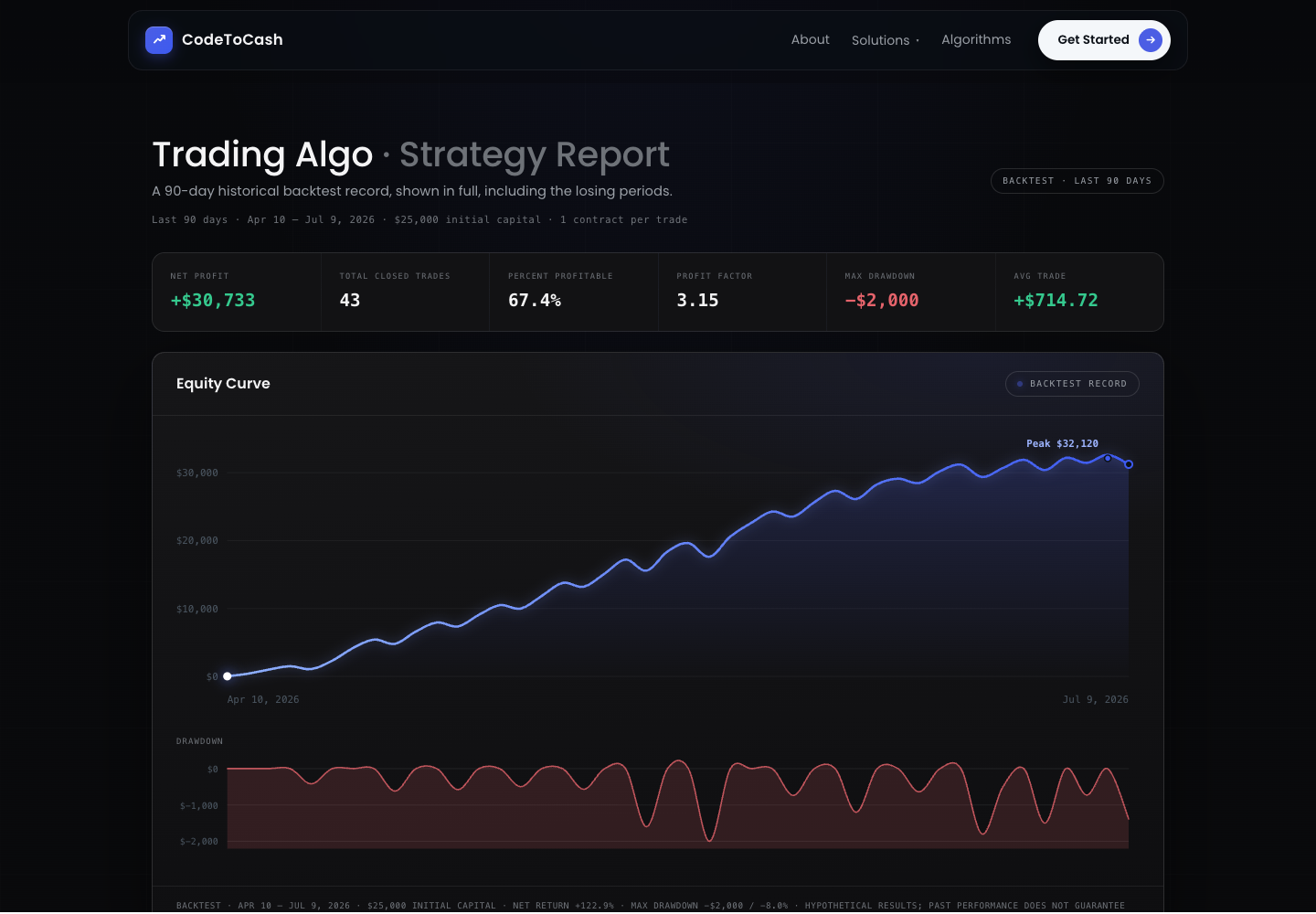
Performance becomes easier to evaluate when the terms are defined consistently across the website, report, sales conversation, and customer documentation.
The change after the included trading results and stated costs, shown against the defined starting capital.
The decline from a prior account high. Its definition and measurement method should be visible.
The number of closed trades included. A small sample can make other statistics less reliable.
The percentage of winning trades. It does not show how large winners and losers were.
Gross profit divided by gross loss. It still depends on the period, sample, and assumptions.
Use these questions with CodeToCashAI or any other automation provider. Good evidence should make direct answers easier, not harder.
Backtest, simulation, live unverified, and live verified records are not interchangeable.
Ask for the drawdown definition, largest losing periods, and whether open-trade movement was included.
Commission, fees, slippage, data, sizing, and execution assumptions can materially change a result.
Market changes, fills, latency, data, platform behavior, broker rules, and technical failures all matter.
You should understand custody, permissions, monitoring, notifications, pause conditions, and shutdown before activation.
An automated process still needs an accountable human. Compatibility, configuration, testing, monitoring, and shutdown are part of responsible implementation.
The free Automated Trading Plan Call reviews your experience, goals, platform, account path, and risk questions. It does not guarantee a trading result.